How to Convert Any Oven Recipe to an Air Fryer
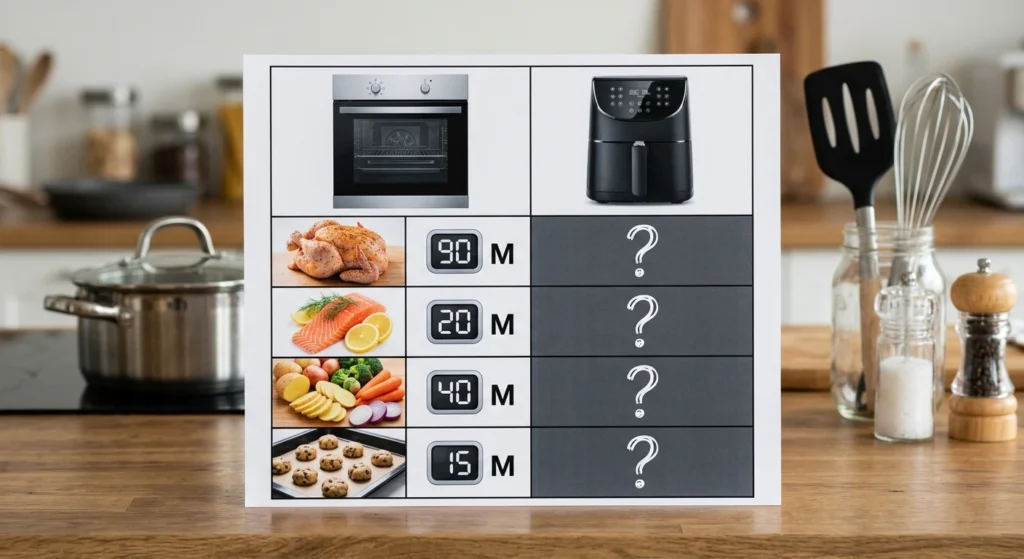
If you have an oven recipe you love and want to know how to adapt it to your air fryer without ruining it, there is a simple method you can follow. You do not need to memorize complicated conversion charts. You mainly need to understand three things: what type of oven the original recipe uses, how much to reduce the temperature and cooking time, and how to adjust the result while cooking.
The 3-Step Method for Converting Any Recipe
- Identify the type of oven used in the original recipe: Does it use a fan/convection setting or a conventional oven? This determines how much you need to adjust the recipe.
- Adjust the temperature and cooking time: Reduce the temperature and cooking time according to the guidelines below.
- Adjust as you cook: Start checking the food before the calculated cooking time is finished and make small adjustments if necessary.
This method works as a useful starting point for many recipes, from roasted chicken and vegetables to cookies and cakes. The principle is simple: an air fryer circulates hot air much more rapidly around the food, so it often needs less temperature and less cooking time than a conventional oven.
We have an article: Air Fryer Oven Conversion Chart for your help.
Why Is There No Exact Universal Conversion?
Every air fryer is slightly different. Power, basket shape, heating element position and the distance between the food and the heating element can all affect cooking.
The same is true of conventional ovens. Therefore, while the general conversion rules provide a good starting point, you may need to make small adjustments depending on your specific appliance and the food you are cooking.
Step 1: Identify Whether the Recipe Uses a Fan Oven or Conventional Oven
Recipes that already specify fan oven, fan-assisted oven or convection oven need a smaller adjustment because the air is already circulating during cooking.
Recipes designed for a conventional oven, using only top and bottom heat without a fan, generally require a larger adjustment when converted to an air fryer.
- Fan/convection oven: reduce the temperature by 10-15°C and the cooking time by around 15-20%.
- Conventional oven: reduce the temperature by 15-20°C and the cooking time by around 20-25%.
Step 2: Adjust the Temperature and Cooking Time
| Situation | Temperature Adjustment | Time Adjustment |
|---|---|---|
| Fan/convection oven | −10 to −15°C | −15% to −20% |
| Conventional oven | −15 to −20°C | −20% to −25% |
| Very thick or dense food | Normal adjustment + check more often | Add 2-4 minute intervals |
| Frozen food | Usually needs a different approach | Check according to the product |
For example, if your original conventional oven recipe says 200°C for 40 minutes, you could start with approximately 180°C for 30 minutes in the air fryer.
That does not mean the food will always be perfect after exactly 30 minutes. It gives you a sensible starting point from which to check and adjust.
What If the Food Is Thicker Than in the Original Recipe?
If your piece of food is larger or thicker than the one specified in the original recipe, keep the adjusted temperature but monitor the cooking process more carefully.
For example, if a recipe calls for a 1.5 kg chicken but you are cooking a 2 kg chicken, do not simply add a large amount of cooking time at once. Check the food periodically and add a few minutes at a time.
This is especially important with meat, where the difference between perfectly cooked and overcooked can be quite small.
Step 3: Adjust the Recipe While Cooking
Once you have calculated the approximate air fryer temperature and cooking time, use the following approach:
- Check the food at around 80% of the calculated cooking time. If your conversion gives you 24 minutes, start checking around the 19-20 minute mark.
- If the outside is browning too quickly, reduce the temperature by another 10-15°C and continue cooking.
- If the center is still undercooked, add 2-4 minutes at a time rather than adding a large amount of extra cooking time.
- Turn or shake the food halfway through cooking when appropriate to encourage more even browning.
Why Should You Avoid Adding All the Extra Cooking Time at Once?
If your initial conversion is slightly too short and you immediately add another 10 minutes, you could easily overcook the food.
Adding a few minutes at a time gives you much more control. This is particularly useful for chicken, fish, pastries and other foods where a small difference in cooking time can significantly change the final texture.
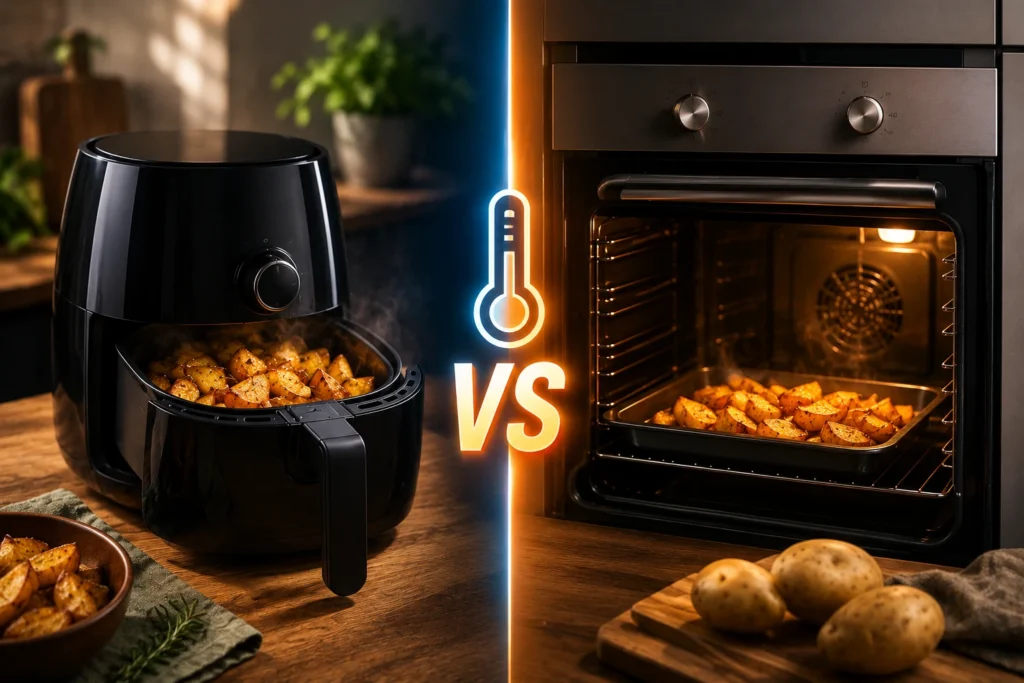
You can see the most important keys for temperature in our article: Air Fryer vs Oven Temperature
Special Cases to Consider
Recipes Made in a Cake Pan or Baking Dish
Cakes, pies, gratins and similar recipes can behave differently because the container absorbs and transfers heat more slowly than food placed directly in the air fryer basket.
You may need to use a slightly lower temperature and allow more time for the center to cook.
For cakes and other delicate baked goods, checking the center with a toothpick is often more reliable than relying exclusively on the calculated cooking time.
Recipes With Lots of Liquid or Sauce
An air fryer is not designed for very liquid recipes in the same way as an oven-safe casserole dish.
Foods with a lot of sauce or liquid may not be suitable for a direct conversion. Air fryers work particularly well with foods that benefit from dry, circulating heat and surface browning.
Frozen Food
Frozen foods should not always be treated exactly like fresh food when converting an oven recipe.
The most important thing is to follow the cooking instructions supplied for the specific frozen product when available. Frozen food may need more cooking time than its fresh equivalent because the center must first thaw and then heat through.
Delicate Batters and Doughs
Cakes, breads and other delicate baked goods generally benefit from a preheated air fryer.
Starting the cooking process in a properly heated chamber helps the dough or batter begin rising immediately and can produce a more predictable result.
Common Mistakes When Converting an Oven Recipe to an Air Fryer
- Using exactly the same temperature as the oven: This is one of the most common mistakes. The food may brown or burn on the outside before the center is properly cooked.
- Using the same adjustment for every type of oven: A fan oven and a conventional oven already distribute heat differently, so they should not always be converted in exactly the same way.
- Adding all the extra cooking time at once: If the food is still undercooked, add small increments and check again.
- Ignoring the size of the food: A thick piece of meat will behave very differently from a thin fillet, even if both recipes use the same oven temperature.
- Overcrowding the air fryer basket: The hot air needs room to circulate. Too much food can increase cooking time and reduce browning.
- Never checking the food during cooking: Air fryers can vary considerably, so the first attempt should be treated as a test that helps you learn how your particular appliance behaves.
Frequently Asked Questions
What is the most reliable formula for converting an oven recipe to an air fryer? As a general starting point, reduce the temperature by around 15-20°C and the cooking time by approximately 20-25% when converting from a conventional oven. If the original recipe uses a fan oven, a smaller adjustment of around 10-15°C and 15-20% less time may be more appropriate.
Can you convert any recipe from an oven to an air fryer? Many recipes can be adapted, particularly meats, fish, vegetables, potatoes, pastries and baked goods. Recipes containing large amounts of liquid or requiring very large cooking vessels are less suitable for a direct conversion.
How do I know if my oven recipe uses a fan? Look for terms such as “fan oven,” “fan-assisted,” “convection” or a fan symbol. If the recipe simply gives a temperature without mentioning convection, it is generally safer to assume that the temperature refers to a conventional oven unless the recipe states otherwise.
What if the recipe does not say whether the oven uses a fan? Start with the more conservative adjustment for a conventional oven. Check the food before the calculated cooking time has finished and use the result to adjust future attempts.
Do I always need to preheat the air fryer when converting an oven recipe? Not always. However, preheating is particularly useful for cakes, breads, pastries and foods where you want to develop a good crust or initial sear.
How do I convert a frozen oven recipe to an air fryer? Start by checking whether the packaging provides air fryer instructions. If not, use the oven instructions as a starting point, but monitor the food carefully because frozen products vary considerably in size, moisture and composition.
What happens if my food is much thicker than the original recipe specifies? Keep the adjusted temperature but expect the cooking time to vary. Check the center regularly and add small increments of 2-5 minutes rather than making one large time adjustment.
Why is my food burned on the outside but raw inside? The temperature is probably too high for the size and thickness of the food. Reduce the temperature and allow more time for the heat to reach the center.
Should I turn or shake food when converting an oven recipe to an air fryer? Often, yes. Turning or shaking halfway through cooking can help expose different surfaces to the circulating hot air and produce more even browning.
Can I convert a cake recipe from an oven to an air fryer? Yes. Cakes can work very well in an air fryer, but you need a suitable small baking pan and usually a lower temperature than the original oven recipe. Check the center with a toothpick before removing the cake.