Air Fryer vs Oven Temperature
If you have ever wondered why an air fryer usually needs a lower temperature and less cooking time than an oven to achieve a similar result, the explanation is fairly simple. Understanding this difference makes it much easier to adapt almost any oven recipe without having to rely on a conversion chart every time.
Key Differences Between an Air Fryer and a Traditional Oven
| Aspect | Air Fryer | Traditional Oven |
|---|---|---|
| Typical temperature range | 40°C–200-230°C | 38°C–250-260°C |
| Hot air speed | Very high, with the fan close to the food | Lower, with more radiant heat |
| Preheating time | 2-5 minutes | 10-20 minutes |
| Energy consumption per use | Around 1.4-1.7 kWh | Around 2.0-2.2 kWh |
| Capacity | 2-8 litres | 30-80 litres |
The main difference is not necessarily the maximum temperature reached by each appliance, but how quickly and directly hot air circulates around the food.
That is the real reason why cooking times and temperatures cannot simply be transferred from an oven to an air fryer. Check our air fryer temperature conversion chart.
Does an Air Fryer Get Hotter Than an Oven?
No. This is a common misconception.
Most domestic air fryers reach maximum temperatures of around 200-230°C, while many traditional ovens can reach 250-260°C.
An air fryer is not necessarily hotter. Instead, it is more efficient at transferring heat because the hot air moves much faster and much closer to the food.
Why Does an Air Fryer Cook Faster at a Lower Temperature?
A traditional oven heats food mainly through a combination of convection and radiant heat. Heating elements radiate heat throughout a relatively large cooking chamber, while the air circulates more slowly.
An air fryer, on the other hand, uses forced convection. A powerful fan pushes hot air rapidly around the food inside a much smaller cooking chamber.
This combination of:
- Faster-moving hot air
- A smaller cooking space
- Food positioned closer to the heating element
- More direct heat transfer
allows an air fryer to cook food faster even when the temperature setting is lower than the one recommended for a traditional oven.
Why Does the Size of the Cooking Chamber Matter?
The smaller the space in which hot air circulates, the less energy is required to heat the chamber.
The food is also exposed to the hot air more directly and quickly.
This is one of the reasons why a small countertop convection oven can often cook food faster than a large built-in oven.
Advantages of Each Appliance Depending on the Type of Cooking
An Air Fryer Is Better For:
- Individual portions or meals for 2-4 people.
- Foods where you want a crispy texture, such as fries and chicken wings.
- Quick weekday meals.
- Reheating food while keeping it relatively crisp.
- Cooking without waiting for a long preheating period.
- Reducing energy use for small meals.
A Traditional Oven Is Better For:
- Large quantities of food.
- Cooking with multiple trays at once.
- Large cakes and breads.
- Large cuts of meat that do not fit inside an air fryer basket.
- Long cooking processes.
- Recipes that require a large, stable cooking environment.
How Does the Difference Affect Your Recipes?
Because an air fryer transfers heat more directly and quickly, using exactly the same temperature as an oven recipe can cause the outside of the food to brown or burn before the inside is properly cooked.
As a general starting point, when adapting an oven recipe to an air fryer, you can try:
Reducing the temperature by around 15-20°C and reducing the cooking time by approximately 20-25%.
However, this is only a starting point. The exact adjustment depends on the food, its size, the recipe and the specific air fryer.
For example, a recipe that calls for 200°C in a conventional oven could initially be tested at around 180-185°C in an air fryer.
It is always better to start checking the food earlier and add a few minutes if necessary.
Why Doesn’t an Air Fryer Always Produce the Same Result as an Oven?
Some recipes depend on having a large cooking chamber and maintaining relatively gentle, even heat for a longer period.
Large loaves of bread, tall cakes and large roasts are good examples.
In these cases, an air fryer may brown the outside before the centre has finished cooking.
The problem is not necessarily the temperature. It can simply be a limitation caused by the size and design of the appliance.
For these recipes, a traditional oven remains the better option.
Air Fryer vs Oven: How to Convert Cooking Times
If you want to adapt an oven recipe for your air fryer, use the following as a starting guide:
| Oven Recipe | Air Fryer Starting Point |
|---|---|
| 200°C | 180-185°C |
| 190°C | 170-175°C |
| 180°C | 160-165°C |
| 170°C | 155-160°C |
| 160°C | 145-150°C |
For cooking time, start by reducing the original oven time by approximately 20-25%.
For example, if an oven recipe takes 30 minutes, start checking the food after approximately 22-24 minutes in the air fryer.
The exact result will depend on the food and the model of air fryer.
Air Fryer vs Oven for Different Foods
Different foods respond differently to the two appliances.
Potatoes and Fries
Air fryers are particularly effective for potatoes because the rapid circulation of hot air helps remove moisture from the surface.
This makes it easier to achieve a crispy exterior without using a large amount of oil.
Chicken
Chicken wings, drumsticks and smaller pieces are especially well suited to air frying.
The strong airflow helps brown the outside while the relatively small cooking chamber allows the food to heat quickly.
For larger chicken pieces, however, you should always check that the centre has reached a safe internal temperature.
Vegetables
Vegetables can work very well in an air fryer, particularly when cut into similar-sized pieces.
Broccoli, cauliflower, peppers, courgettes and asparagus can all develop browned, roasted edges relatively quickly.
Cakes and Bread
Small cakes and individual baked goods can work well in an air fryer.
However, large cakes and tall loaves can be more difficult because the intense airflow and compact cooking space can cause the outside to brown before the centre is fully cooked.
Does an Air Fryer Use Less Energy Than an Oven?
For small meals, an air fryer will often use less electricity than a full-size oven because it has a much smaller cooking chamber and generally requires less preheating.
However, the exact energy consumption depends on the appliance, cooking temperature, cooking time and how the oven is used.
For a single portion or a small meal, heating a large oven can be unnecessary.
For a large family meal where you need several trays at once, a full-size oven can be more practical and may make better use of its capacity.
Which Is Better for Everyday Cooking?
For one or two people, an air fryer can be extremely convenient for everyday meals.
It heats quickly, takes up less space and is particularly good for small portions of foods that benefit from a crispy exterior.
For larger households, the answer depends on the amount of food you normally prepare.
A large air fryer can handle many everyday meals, but a traditional oven remains more practical when you need to cook several dishes or large quantities at the same time.
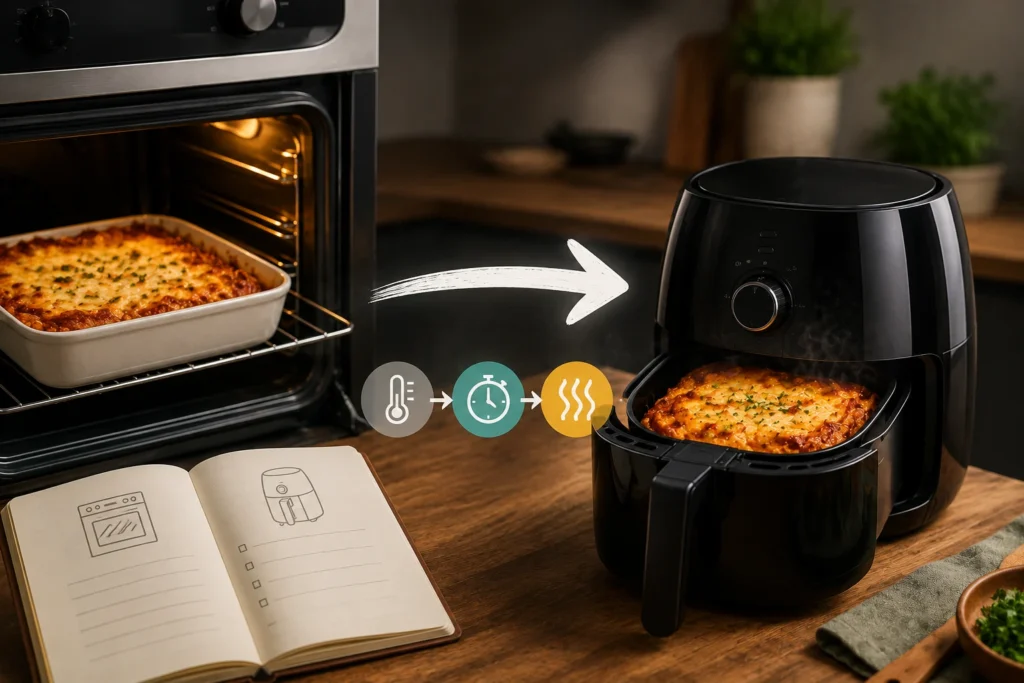
Discover how to adapt oven cooking times and temperatures to an air fryer.
Common Mistakes When Converting Oven Recipes to an Air Fryer
Using exactly the same temperature
This can cause food to brown too quickly on the outside.
Starting with a slightly lower temperature is usually safer.
Keeping exactly the same cooking time
Air fryers often cook faster, so check the food before the original oven cooking time has elapsed.
Overfilling the basket
The hot air needs space to circulate.
If the basket is too full, food can cook unevenly and become less crispy.
Forgetting that food size matters
A whole chicken breast and thin chicken strips may require completely different cooking times even if they are technically the same food.
The thickness of the food is often more important than its total weight.
Opening the basket too often
Every time you open the air fryer, some heat escapes.
Try to check the food only when necessary, especially during shorter cooking processes.
Frequently Asked Questions About Air Fryer vs Oven Temperatures
Does an air fryer reach higher temperatures than an oven?
Generally, no. Most domestic air fryers reach around 200-230°C, while many traditional ovens can reach 250-260°C. The air fryer often feels more powerful because it transfers heat more efficiently through rapid air circulation.
Why does food cook faster in an air fryer if the temperature is lower?
Because hot air moves rapidly around the food and the cooking chamber is much smaller. This allows heat to reach the surface of the food more efficiently.
Does an oven or air fryer use more energy?
For small meals, an air fryer will often use less energy because it heats a much smaller space and usually requires less preheating. Actual consumption varies depending on the appliance and cooking time.
Is an air fryer better for everyday cooking?
For small and medium portions, it can be more convenient because it heats quickly and cooks relatively fast. For large family meals, a traditional oven still has the advantage of greater capacity.
Can an air fryer completely replace an oven?
Not in every situation. An air fryer can replace much of the everyday cooking for one or two people, but large cakes, large loaves, big roasts and meals requiring multiple trays are still better suited to a traditional oven.
Why doesn’t my oven recipe turn out the same in an air fryer?
Some recipes depend on the larger cooking space and gentler heat distribution of an oven. Adjusting the temperature and cooking time helps, but it cannot completely eliminate the physical differences between the two appliances.
How much should I reduce the temperature when converting an oven recipe to an air fryer?
A reduction of around 15-20°C is a useful starting point. However, you should adjust it according to the food and your particular air fryer.
How much should I reduce the cooking time?
A reduction of approximately 20-25% is a reasonable starting point. Check the food early and add more cooking time if necessary.
Why does an air fryer make food crispy with less oil than an oven?
The rapid circulation of hot air helps remove moisture from the surface of the food quickly. This promotes browning and crisping without requiring the food to be submerged in oil.
Is an air fryer basically just a small convection oven?
In principle, yes. Both appliances use heating elements and hot air, but an air fryer combines a compact cooking chamber with strong forced-air circulation. This makes it a particularly efficient type of countertop convection cooker.
Which is better for a one- or two-person household?
An air fryer is often more practical for smaller households because it heats quickly and works particularly well for individual portions. A traditional oven can remain useful for larger recipes and occasional cooking that requires more capacity.
Conclusion
Understanding the difference between an air fryer and a traditional oven makes adapting recipes much easier.
An air fryer does not necessarily cook at a higher temperature. Its advantage comes from rapid forced convection, a smaller cooking chamber and more direct heat transfer.
As a general starting point, reduce the oven temperature by around 15-20°C and the cooking time by approximately 20-25% when adapting a recipe.
But don’t treat these numbers as fixed rules. The type, size and thickness of the food, as well as the specific air fryer model, can make a significant difference.
For small portions, crispy foods and quick everyday meals, an air fryer can be extremely efficient. For large quantities, multiple trays and large baked goods, the traditional oven still has a clear advantage.
The best approach is to use the conversion as a starting point, check the food early and adjust the temperature and cooking time until you learn how your particular air fryer behaves.